Max Loss Management: When to Take the Loss and Move On
Max Loss Management: When to Take the Loss and Move On Max Loss Management: When to Take the Loss and Move On In the dynamic world of options trading, the pursuit of profit often overshadows the critical importance of managing risk. While every trader dreams of hitting a grand sl
Abstract
Max Loss Management: When to Take the Loss and Move On Max Loss Management: When to Take the Loss and Move On In the dynamic world of options trading, the pursuit of profit often overshadows the critical importance of managing risk. While every trader dreams of hitting a grand sl
Max Loss Management: When to Take the Loss and Move On
In the dynamic world of options trading, the pursuit of profit often overshadows the critical importance of managing risk. While every trader dreams of hitting a grand slam, the reality is that losses are an inevitable part of the game. The true mark of a professional trader isn't just about how much they make, but how effectively they manage what they lose. At Volatility Anomaly, we preach a disciplined approach to risk, understanding that preserving capital is paramount to long-term success. This article delves deep into a fundamental, yet often overlooked, aspect of options trading: max loss management. We will explore concrete strategies, including defining clear options stop loss rules like the "2x credit received" principle, and dissect the psychological and mathematical underpinnings that compel us to cut losses early and move on.
Many traders enter positions with a clear profit target but a vague exit strategy for when things go wrong. This oversight can quickly erode an account, turning small, manageable losses into catastrophic drawdowns. Our focus today is on building a robust framework for identifying when a trade has gone awry and, more importantly, possessing the discipline to exit. We'll provide actionable insights, real-world examples with specific tickers like SPY and QQQ, and numerical thresholds (delta values, IV rank, VIX levels) to guide your decision-making process. By the end of this deep dive, you'll have a clearer understanding of how to implement effective options risk management, ensuring that no single trade ever threatens your overall trading career.
The Unavoidable Reality: Why Max Loss Management Matters Now
The current market environment, characterized by periods of elevated volatility and rapid shifts in sentiment, makes robust options risk management more crucial than ever. We've seen the VIX fluctuate wildly, from lows around 12-15 during calm periods to spikes above 30-40 during significant market events. Such volatility can quickly turn a seemingly safe options strategy into a precarious one. For instance, an iron condor, a strategy often favored for its defined risk, can experience rapid erosion of its short strikes if the underlying moves aggressively against the expected range.
Consider the recent market dynamics: interest rates are higher, inflation remains a concern, and geopolitical tensions persist. These factors contribute to an environment where market corrections can be swift and unforgiving. In such a landscape, relying solely on "hope" or "waiting for it to come back" is a recipe for disaster. The average retail trader often struggles with the psychological hurdle of taking a loss, leading to paralysis or doubling down on losing positions. This is precisely why a predefined, quantitative options stop loss rule is indispensable.
At Volatility Anomaly, our automated screener often identifies opportunities in various market conditions, from high IV environments favoring credit spreads to low IV environments for debit spreads. Regardless of the strategy, the underlying principle of capital preservation remains constant. A well-defined max loss rule acts as your ultimate safety net, protecting your capital when even the most sophisticated analysis fails to predict market movements. Without it, even a few bad trades can wipe out weeks or months of profitable trading. This isn't just about minimizing individual trade losses; it's about safeguarding your entire trading account and ensuring longevity in the market.
Defining Your Options Stop Loss: The "2x Credit Received" Rule and Beyond
The cornerstone of effective max loss management in options trading, particularly for credit strategies like iron condors, credit spreads, and short strangles, is a clearly defined options stop loss. While there are various approaches, one of the most widely adopted and effective rules is the "2x Credit Received" principle. This rule provides a simple, quantifiable threshold for when to exit a losing position.
The "2x Credit Received" Rule Explained
For credit strategies, you collect a premium upfront. The "2x credit received" rule dictates that if the unrealized loss on your position reaches approximately twice the initial credit collected, it's time to close the trade and take the loss. Let's break down the rationale:
- Risk-Reward Symmetry: If you collect $1.00 in premium, your maximum profit is $100 (minus commissions). If you allow the loss to exceed $200, your potential loss is now twice your potential gain. This imbalance significantly skews your long-term probability of success.
- Capital Preservation: By limiting losses to 2x the credit, you prevent a single losing trade from wiping out multiple winning trades. For example, if you consistently make $100 per winning trade, a single loss exceeding $200 would require three winning trades just to break even from that one losing position.
- Psychological Discipline: This rule removes emotional decision-making. When the market moves against you, it's easy to rationalize holding on. A hard stop loss rule forces you to act decisively, regardless of your emotions.
- Mathematical Edge: Over a large sample size of trades, adhering to this rule helps maintain a positive expectancy. Even with a win rate slightly above 50%, managing your losses effectively can lead to consistent profitability.
Other Quantitative Max Loss Triggers
While 2x credit is a solid starting point, other quantitative triggers can complement or even replace it, depending on the strategy and market conditions:
- Percentage of Max Loss: For defined risk strategies like iron condors, you have a theoretical maximum loss. Some traders prefer to exit when they've lost a certain percentage of that maximum, e.g., 25% or 50% of the max loss. For an iron condor with a $5.00 wide spread and $1.00 credit, the max loss is $4.00. A 50% max loss trigger would mean exiting at a $2.00 loss. This often aligns closely with the 2x credit rule.
- Delta Thresholds: For short options (puts or calls), if the delta of your short strike moves significantly against you, it's a strong signal. For example, if you sold a 0.15 delta put and the underlying drops, causing that put's delta to increase to -0.35 or -0.40, it indicates a substantial shift in probability against your position. This is particularly useful for undefined risk strategies like short straddles or strangles.
- Underlying Price Breach: For credit spreads, if the underlying asset breaches your short strike or even your long strike, it's a clear indication that your thesis is wrong. For a short put spread (e.g., SPY 450/445 put spread), if SPY drops below 445, the spread is fully in the money, and the loss is approaching its maximum.
- Implied Volatility (IV) Spike: For strategies that are short volatility (e.g., short strangles, iron condors), a sudden spike in IV (e.g., VIX jumping from 18 to 25, or the underlying's IV Rank moving from 30% to 70%) can rapidly inflate the price of your short options, increasing your unrealized loss. While not a direct loss trigger, it can be a warning sign to reassess or tighten your stop.
The key is to define these rules before entering the trade. Write them down as part of your trade plan. This proactive approach eliminates emotional bias and provides a clear roadmap for action when the market inevitably moves against you.
Practical Application: Implementing Your Options Stop Loss
Let's walk through a concrete example of how to apply these principles using a common options strategy: the iron condor. We'll use a hypothetical scenario involving SPY, the S&P 500 ETF, which is highly liquid and widely traded.
Case Study: SPY Iron Condor
Date: October 23, 2023
Market Conditions:
- SPY Price: $420.00
- VIX: 18.50
- SPY IV Rank: 45% (moderate IV environment)
- Market Sentiment: Slightly bearish, but expected to consolidate.
Strategy: Sell an Iron Condor on SPY, targeting a 0.10-0.15 delta for the short strikes, with 30-45 days to expiration (DTE).
Trade Entry (Hypothetical):
Let's assume we identify the following strikes for a November 24, 2023 expiration (32 DTE):
- Short Call Spread: Sell SPY Nov 24 430 Call (Delta ~0.15), Buy SPY Nov 24 435 Call (Delta ~0.08)
- Short Put Spread: Sell SPY Nov 24 410 Put (Delta ~-0.15), Buy SPY Nov 24 405 Put (Delta ~-0.08)
This creates a $5.00 wide spread on both sides.
Credit Received:
- Short Call Spread (430/435): Collect $0.75
- Short Put Spread (410/405): Collect $0.75
- Total Credit Received: $1.50 (or $150 per contract)
Max Profit: $1.50 ($150)
Max Loss (Theoretical): Spread Width - Credit = $5.00 - $1.50 = $3.50 ($350)
Defining the Options Stop Loss
Using the "2x Credit Received" rule:
- Stop Loss Trigger: 2 x $1.50 = $3.00
- This means if the value of the entire iron condor position (the debit to close it) reaches $3.00, we exit.
- Alternatively, this can be viewed as an unrealized loss of $1.50 (since we collected $1.50, a $3.00 debit to close means we've lost $1.50 from our initial credit).
Let's also consider a delta threshold for our short strikes. If the delta of either short 430 Call or 410 Put approaches 0.35-0.40, it's a strong warning signal.
Scenario 1: Market Moves Against the Put Side
Date: November 1, 2023 (23 DTE)
Market Action: SPY drops sharply due to unexpected inflation data.
- SPY Price: $408.00
- VIX: 22.00 (IV has increased)
- Short 410 Put Delta: -0.42 (significantly increased)
At this point, the short 410 put is now in the money, and the 405 put is close to being in the money. The value of the entire iron condor has increased significantly.
- Value of 430/435 Call Spread: Now worth $0.10 (decayed)
- Value of 410/405 Put Spread: Now worth $2.80 (increased significantly)
- Total Debit to Close: $0.10 + $2.80 = $2.90
Action: The total debit to close ($2.90) is very close to our $3.00 stop loss trigger. The short put delta (-0.42) has also breached our warning threshold. This is the time to act decisively. Close the entire iron condor for a debit of $2.90.
Result:
- Initial Credit: $1.50
- Debit to Close: $2.90
- Net Loss: $1.40 ($140 per contract)
This loss is within our 2x credit rule ($1.40 < $3.00). We took the loss, protected our capital, and can now redeploy that capital into a new, higher-probability trade.
Scenario 2: Market Stays Within Range (Successful Trade)
Date: November 20, 2023 (4 DTE)
Market Action: SPY consolidates within our range.
- SPY Price: $422.00
- VIX: 16.00 (IV has decreased)
- Short 430 Call Delta: 0.05
- Short 410 Put Delta: -0.05
Both short strikes are far out-of-the-money, and time decay has worked in our favor.
- Value of 430/435 Call Spread: Now worth $0.05
- Value of 410/405 Put Spread: Now worth $0.05
- Total Debit to Close: $0.05 + $0.05 = $0.10
Action: Close the iron condor for a small debit to realize maximum profit (or let it expire worthless if the debit is negligible, e.g., less than $0.05). In this case, we close for $0.10.
Result:
- Initial Credit: $1.50
- Debit to Close: $0.10
- Net Profit: $1.40 ($140 per contract)
This example highlights how a disciplined approach to both profit-taking and loss-cutting ensures consistency. Our Volatility Anomaly position monitoring tools would alert you to these changes in real-time, helping you execute your predefined plan.
Risk Management: What Can Go Wrong and How to Protect Yourself
Even with the best intentions and a well-defined options stop loss, options trading carries inherent risks. Understanding these risks and having contingency plans is crucial for robust options risk management.
Common Pitfalls and How to Mitigate Them:
-
Gap Risk: This is arguably the biggest threat to options strategies, especially those with short options. A market-moving event (e.g., earnings, geopolitical news, economic data) can cause the underlying to gap significantly overnight or over a weekend, blowing past your stop loss level.
Mitigation:
- Avoid holding positions over earnings: This is a cardinal rule for short premium strategies. The IV crush after earnings is tempting, but the gap risk is too high.
- Reduce position size: If you must hold over a weekend or during a period of heightened uncertainty, significantly reduce your contract count.
- Use wider spreads: For credit spreads, wider wings offer more buffer against small gaps, though they also reduce credit received.
- Consider defined risk strategies only: For newer traders, stick to iron condors or credit spreads where your maximum loss is theoretically capped, even if a gap exceeds your stop loss.
-
Liquidity Risk: Trying to exit a losing position in an illiquid option can be costly. Wide bid-ask spreads mean you'll pay more to close your debit, further exacerbating your loss.
Mitigation:
- Trade highly liquid underlying assets: Focus on major ETFs (SPY, QQQ, IWM), large-cap stocks (AAPL, MSFT, GOOGL), and high-volume options.
- Check bid-ask spreads before entry: If the spread is consistently wide (e.g., $0.10+ on a $0.50 option), rethink the trade.
- Use limit orders for exits: Don't use market orders, especially when exiting a losing trade. Place a limit order slightly inside the bid-ask spread and be patient.
-
Emotional Bias (Hope vs. Discipline): The hardest part of max loss management is the psychological battle. Hope that the market will turn around, fear of realizing a loss, or the sunk cost fallacy can lead traders to ignore their predefined stop loss.
Mitigation:
- Predefine your rules: As discussed, write down your exit criteria before entering the trade.
- Automate alerts: Use your broker's alerts or tools like Volatility Anomaly's position monitoring to notify you when a stop loss is hit.
- Practice simulated trading: Develop the discipline in a risk-free environment.
- Review losing trades: Analyze why the stop loss was hit and if your initial thesis was flawed, but without self-recrimination. Focus on learning.
-
Over-Leverage: Taking on too many contracts relative to your account size means even a small percentage loss can be devastating.
Mitigation:
- Position sizing rules: Risk only 1-2% of your total account capital on any single trade. If your max loss on an iron condor is $350, and you have a $10,000 account, you should only trade 1-2 contracts.
- Understand margin requirements: Be aware of how much margin your broker requires and how much buffer you have.
Effective options risk management isn't just about setting a stop loss; it's about a holistic approach that encompasses position sizing, liquidity considerations, and psychological fortitude. The "2x credit received" rule is a powerful tool, but it must be applied within a broader framework of disciplined trading.
Advanced Considerations for Experienced Traders
For seasoned options traders, max loss management can evolve beyond simple static rules. While the "2x credit received" rule remains a robust foundation, experienced traders often incorporate dynamic adjustments and more nuanced strategies.
Rolling a Losing Position
Instead of outright closing a losing position, experienced traders might consider "rolling" it. This involves closing the current losing spread and simultaneously opening a new spread in a further expiration cycle, potentially at different strikes, to collect additional credit and give the trade more time to recover.
- When to Consider Rolling:
- The underlying has moved against you but is showing signs of stabilization or mean reversion.
- Implied volatility has spiked significantly, allowing you to collect substantial credit for the roll.
- Your thesis for the underlying's long-term movement is still intact, but the short-term move was unexpected.
- You can roll for a net credit that reduces your overall potential loss or even creates a breakeven point.
- Risks of Rolling:
- "Throwing good money after bad": If your initial thesis is fundamentally flawed, rolling simply delays the inevitable and can increase your total loss.
- Increased DTE and Exposure: Rolling further out in time means more exposure to market events and potentially more capital tied up.
- Margin implications: Rolling can sometimes increase margin requirements.
- Example: If your SPY 410/405 put spread is breached, you might roll it to a new 405/400 put spread in the next month's expiration, collecting an additional $0.50-$0.75 in credit. This reduces your effective cost basis and gives SPY more time to recover above 405. However, this is a management technique, not a replacement for a definitive exit strategy if the roll itself becomes untenable.
Hedging with Other Strategies
Instead of closing, some traders might hedge a losing position with another strategy. For instance, if a short put spread on QQQ is under pressure, a trader might buy a cheap, far out-of-the-money put option or even a small number of QQQ shares to partially offset further downside. This is complex and requires a deep understanding of delta and gamma hedging.
Psychological Resilience and the "Mental Stop Loss"
Beyond the quantitative, experienced traders develop a strong "mental stop loss." This isn't about ignoring rules, but about recognizing when the market narrative has fundamentally shifted, rendering the initial trade thesis invalid, even if the quantitative stop hasn't been hit yet. This requires a high degree of market intuition and self-awareness.
- Example: You sold an AAPL iron condor expecting consolidation. Suddenly, AAPL announces a major product recall or a significant earnings miss that fundamentally changes its outlook. Even if your 2x credit rule isn't hit, the underlying reason for your trade is gone. An experienced trader might exit early, recognizing the new paradigm.
At Volatility Anomaly, our weekly picks and market commentary aim to provide the context and analysis that can help you develop this market intuition. However, it's crucial to remember that advanced techniques like rolling or hedging should only be employed after mastering the fundamental options stop loss rules. They are tools for refinement, not for avoiding necessary losses.
Conclusion & Key Takeaways
The journey to becoming a consistently profitable options trader is paved not just with winning trades, but with the disciplined management of losing ones. Max loss management is not merely a suggestion; it's a non-negotiable pillar of sustainable trading. By embracing clear, quantitative options stop loss rules like the "2x credit received" principle, you transform potential account-crippling drawdowns into manageable learning experiences. This proactive approach safeguards your capital, reduces emotional stress, and frees you to pursue new, higher-probability opportunities.
Remember, the market doesn't care about your feelings or your initial thesis. It only responds to supply and demand. Your job as a trader is to adapt, protect your capital, and live to trade another day. At Volatility Anomaly, we empower traders with the knowledge and tools to navigate these complexities. Implement these strategies, practice them diligently, and watch your trading discipline — and ultimately, your account balance — grow.
Key Takeaways for Effective Options Risk Management:
- Define Your Options Stop Loss BEFORE Entry: Always know your exit point for a losing trade before you even open the position.
- Embrace the "2x Credit Received" Rule: For credit strategies, if the unrealized loss reaches approximately twice the initial credit collected, close the trade. This is a powerful iron condor max loss rule.
- Utilize Quantitative Triggers: Supplement the 2x rule with delta thresholds (e.g., short strike delta approaching 0.35-0.40), underlying price breaches, or significant IV spikes as warning signs.
- Mitigate Gap Risk: Avoid holding short premium positions over earnings, reduce position size during uncertain periods, and use liquid underlying assets.
- Overcome Psychological Hurdles: Stick to your predefined plan. Emotional trading is the enemy of consistent profitability. Use alerts and review losing trades objectively.
- Prioritize Position Sizing: Never risk more than 1-2% of your total account capital on any single trade to prevent catastrophic losses.
- Consider Advanced Techniques (with Caution): Rolling or hedging can be useful for experienced traders, but only as a refinement of your core options risk management, not as an escape from taking a necessary loss.
#VolatilityAnomaly · #IVRank · #OptionsTrading · #VRP
You Might Also Like

Volatility Anomaly
Portfolio-Level Hedging for Iron Condor Traders: Using VIX Calls as Insurance
Portfolio-Level Hedging for Iron Condor Traders: Using VIX Calls as Insurance Portfolio-Level Hedging for Iron Condor Traders: Using VIX Calls as Insurance In the world of options trading, strategies like the Iron Condor are highly popular for their ability to generate consistent
Jan 1970
Volatility Anomaly
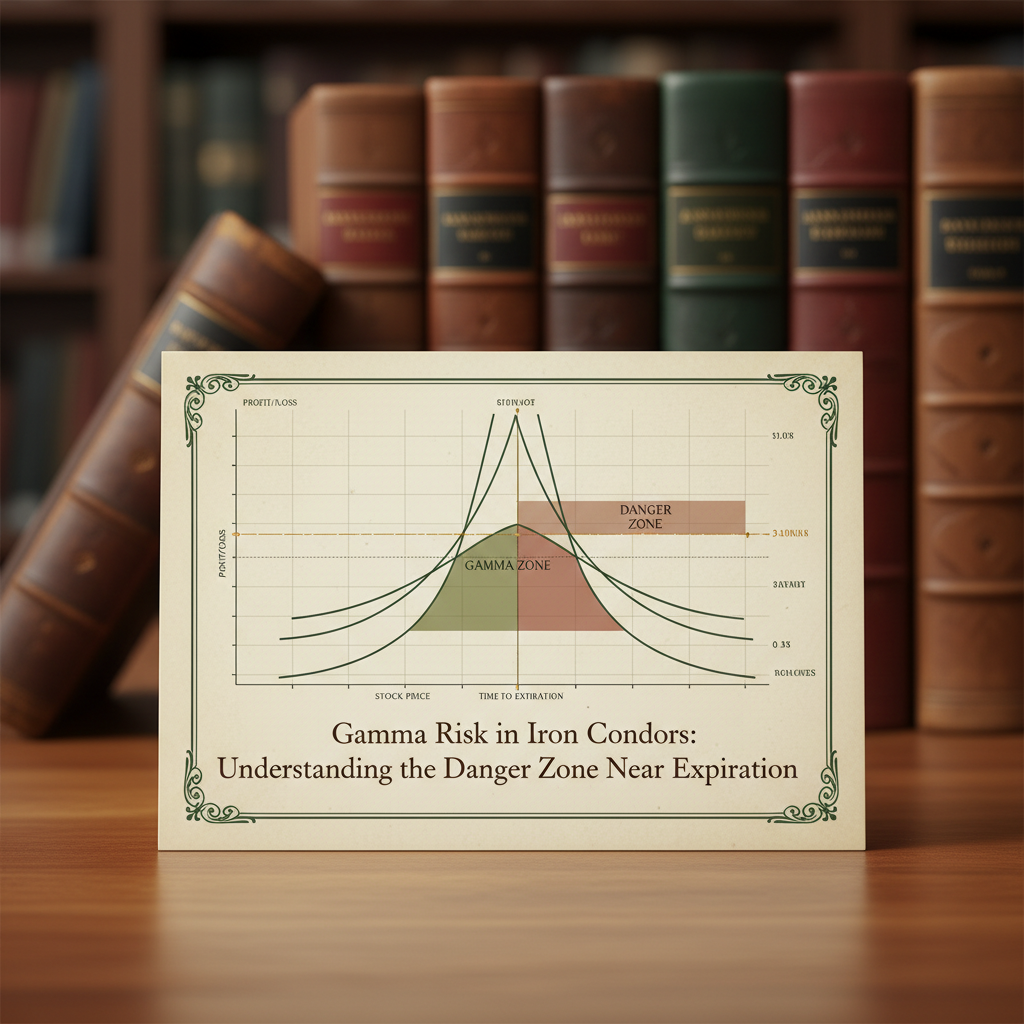
Gamma Risk in Iron Condors: Understanding the Danger Zone Near Expiration
Gamma Risk in Iron Condors: Understanding the Danger Zone Near Expiration As options traders, we often seek strategies that offer defined risk and a high probability of profit. The iron condor, a staple in many portfolios, perfectly embodies this philosophy. By selling out-of-the
Jan 1970
YOU MIGHT ALSO LIKE
Portfolio-Level Hedging for Iron Condor Traders: Using VIX Calls as Insurance
Portfolio-Level Hedging for Iron Condor Traders: Using VIX Calls as Insurance Portfolio-Level Hedging for Iron…
Read articleGamma Risk in Iron Condors: Understanding the Danger Zone Near Expiration
Gamma Risk in Iron Condors: Understanding the Danger Zone Near Expiration As options traders, we often seek st…
Read articleThe 50% Profit Target Rule: Why Closing Early Improves Your Long-Term Returns
The 50% Profit Target Rule: Why Closing Early Improves Your Long-Term Returns In the dynamic world of options…
Read articleThis article is for educational purposes only and does not constitute financial or investment advice. Options trading involves significant risk of loss and is not suitable for all investors. Past performance is not indicative of future results.