Understanding the VIX Futures Term Structure: A Trader's Edge
The VIX futures term structure — contango vs. backwardation — is one of the most powerful tools available to options traders. Learn how to read the curve and use it to time iron condor entries.
Abstract
The VIX futures term structure — contango vs. backwardation — is one of the most powerful tools available to options traders. Learn how to read the curve and use it to time iron condor entries.
Understanding the VIX Futures Term Structure: A Trader's Edge
The VIX futures term structure — the curve formed by VIX futures contracts at different expiration dates — is one of the most powerful and underutilized tools available to options traders.
When you understand how to read this curve, you gain a significant informational edge over market participants who focus solely on the spot VIX number.
In this article, we examine the mechanics of the VIX term structure, how it shifts between contango and backwardation, and how iron condor traders can use these signals to time entries, adjust position sizing, and anticipate regime changes before they appear in price action.
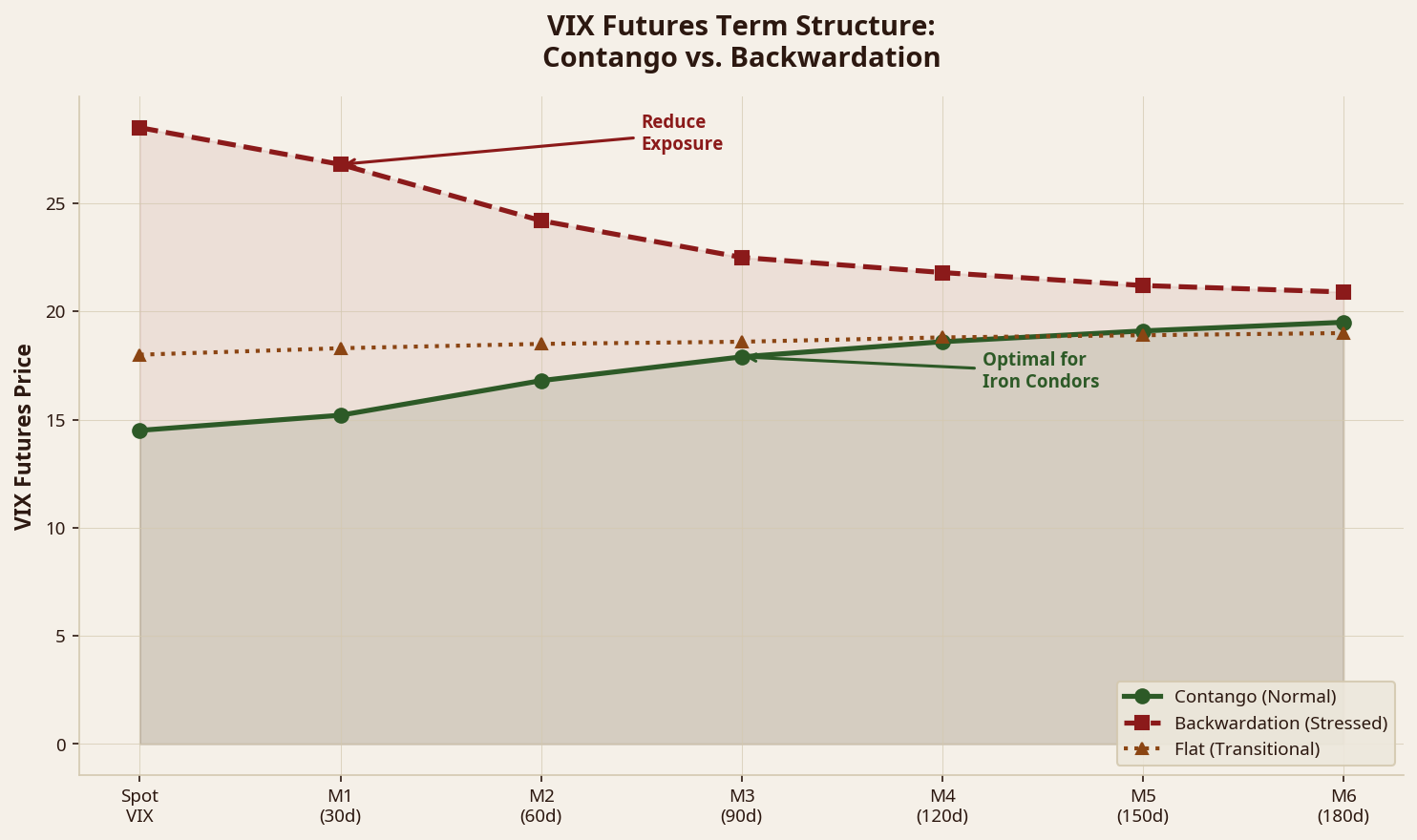
Figure 1: VIX futures term structure in contango (normal) vs. backwardation (stressed). The slope of the curve signals the market's forward volatility expectations.
What the Term Structure Tells You
The VIX term structure plots the prices of VIX futures contracts from the front month out to six or more months.
In normal market conditions, this curve slopes upward — a state called contango. This means the market expects volatility to be higher in the future than it is today, which is the natural resting state of a calm, trending market.
When the curve flattens or inverts — with near-term futures trading above longer-dated ones — the market is in backwardation. This signals acute near-term fear: traders are paying a premium for immediate volatility protection.
Backwardation is the hallmark of crisis periods: March 2020, August 2015, October 2008.
For premium sellers, the distinction is critical. A steep contango curve is your best friend — it means you're selling expensive near-term implied volatility while the market expects calm ahead.
Backwardation, by contrast, is a warning signal to reduce size or stand aside entirely.
The Contango Roll Yield Advantage
One of the most important but least discussed aspects of the term structure is the roll yield it generates for short-volatility strategies.
When VIX futures are in contango, the front-month contract is cheaper than the second-month contract. As time passes, the front-month contract "rolls down" the curve toward the spot VIX — meaning its price declines as expiration approaches (assuming spot VIX stays stable).
This roll yield is the structural tailwind behind the long-run profitability of premium-selling strategies.
It's why iron condors, short strangles, and cash-secured puts have historically outperformed buy-and-hold strategies on a risk-adjusted basis in calm markets. You are, in effect, harvesting the contango premium every month.
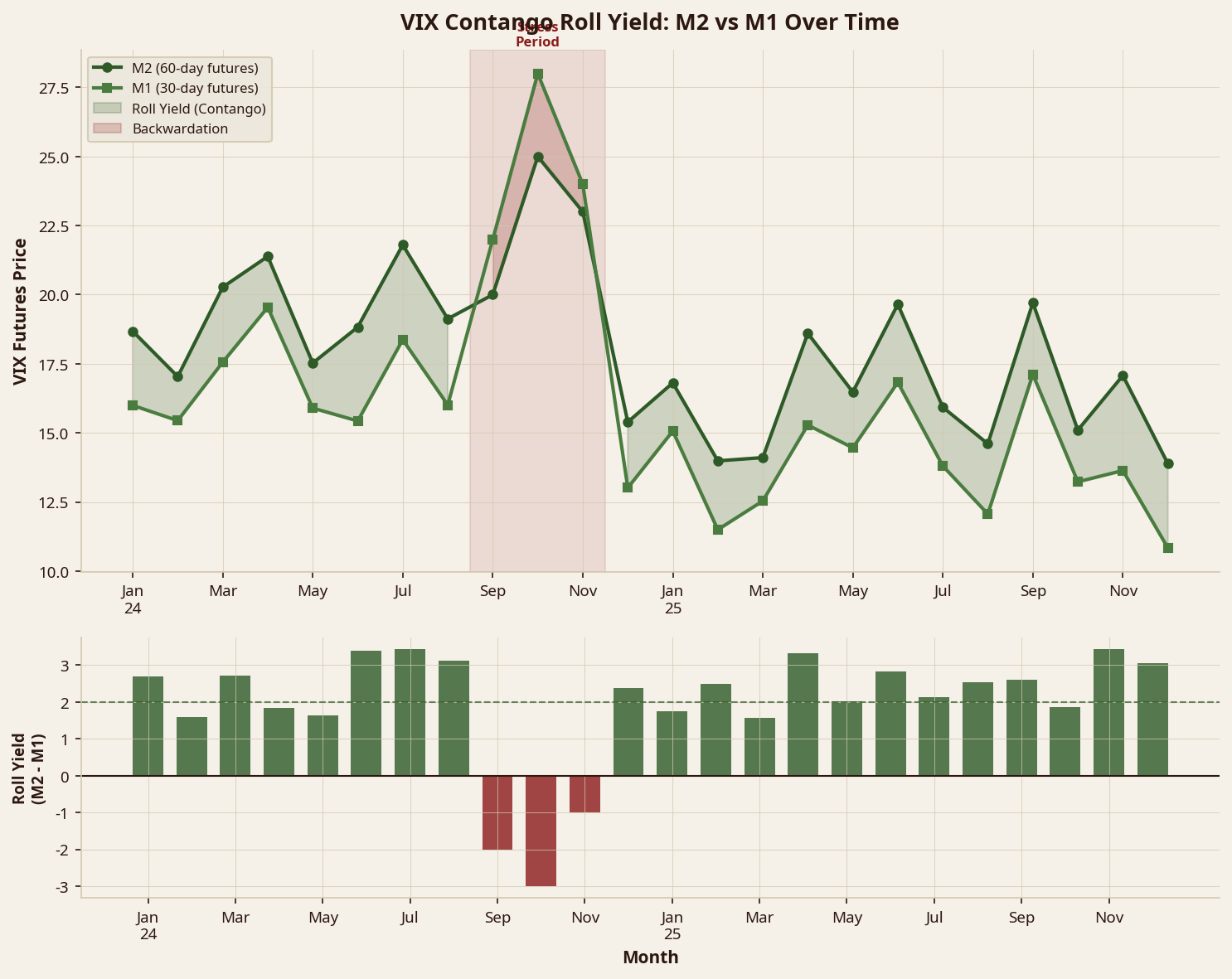
Figure 2: The roll yield from VIX contango — the gap between front-month and second-month VIX futures — represents the structural premium available to short-volatility traders each month.
Reading the Curve: Practical Signals
Here is how to interpret the VIX term structure in practice:
Steep Contango (M2/M1 ratio > 1.10)
This is the optimal environment for iron condors. The market is calm, implied volatility is elevated relative to realized volatility, and the roll yield is substantial. Increase position size and target wider strikes.
Flat Contango (M2/M1 ratio 1.00–1.10)
A neutral environment. Maintain standard position sizing. Monitor for any shift toward backwardation, which would signal deteriorating conditions.
Backwardation (M2/M1 ratio < 1.00)
Reduce exposure immediately. This is not a time to be aggressively selling premium. If you have open positions, consider tightening stops or closing early.
Wait for the curve to return to contango before re-entering.
The VIX9D/VIX Ratio as a Leading Indicator
The 9-day VIX (VIX9D) measures expected volatility over the next nine days, compared to the standard VIX which measures the next 30 days.
When VIX9D spikes above the standard VIX, it signals acute short-term fear — often a precursor to the broader term structure shifting into backwardation.
Monitoring the VIX9D/VIX ratio gives you a 1–3 day early warning before the full term structure inverts. A ratio above 1.15 warrants caution; above 1.30 is a strong signal to reduce risk.
This indicator is particularly useful during earnings seasons and FOMC weeks when short-term volatility can spike independently of longer-term expectations.
Integrating Term Structure Into Your Workflow
The most effective way to use the VIX term structure is as a filter, not a standalone signal.
Before entering any new iron condor position, check three things:
First, is the term structure in contango? If not, do not enter. Second, what is the steepness of the contango?
A steeper curve justifies larger positions. Third, has the curve been stable for at least 5 trading days? Rapid flattening of the curve, even while still in contango, can signal a regime change in progress.
By combining term structure analysis with IV rank (IVR) and the VIX9D/VIX ratio, you create a multi-factor filter that significantly improves the quality of your entries and reduces the frequency of being caught in volatility spikes with maximum-size positions.
Conclusion
The VIX futures term structure is a real-time window into the market's collective volatility expectations across time horizons.
For iron condor traders, it provides three critical pieces of information: the current volatility regime (contango vs. backwardation), the magnitude of the roll yield available, and early warning signals of regime transitions.
Traders who incorporate term structure analysis into their entry criteria consistently report fewer catastrophic losses and more consistent premium capture — not because they avoid all volatility events, but because they are systematically underexposed when the market is most dangerous and fully deployed when conditions are most favorable.
#VolatilityAnomaly · #IVRank · #OptionsTrading · #VRP
You Might Also Like

Volatility Anomaly
Tax Efficiency in Options Trading: How Iron Condors Are Taxed and How to Optimize
Tax Efficiency in Options Trading: How Iron Condors Are Taxed and How to Optimize Tax Efficiency in Options Trading: How Iron Condors Are Taxed and How to Optimize In the dynamic world of options trading, profitability isn't solely determined by successful trade execution. A crit
Jan 1970

Volatility Anomaly
Stress Testing Your Iron Condor Portfolio: What Happens in a 10% Market Drop
Stress Testing Your Iron Condor Portfolio: What Happens in a 10% Market Drop Stress Testing Your Iron Condor Portfolio: What Happens in a 10% Market Drop "The market is a device for transferring money from the impatient to the patient." – Warren Buffett. But even the patient need
Jan 1970
YOU MIGHT ALSO LIKE
Tax Efficiency in Options Trading: How Iron Condors Are Taxed and How to Optimize
Tax Efficiency in Options Trading: How Iron Condors Are Taxed and How to Optimize Tax Efficiency in Options Tr…
Read articleStress Testing Your Iron Condor Portfolio: What Happens in a 10% Market Drop
Stress Testing Your Iron Condor Portfolio: What Happens in a 10% Market Drop Stress Testing Your Iron Condor P…
Read articleThe Greeks Explained for Iron Condor Traders: Delta, Theta, Vega, and Gamma
The Greeks Explained for Iron Condor Traders: Delta, Theta, Vega, and Gamma The Greeks Explained for Iron Cond…
Read articleThis article is for educational purposes only and does not constitute financial or investment advice. Options trading involves significant risk of loss and is not suitable for all investors. Past performance is not indicative of future results.