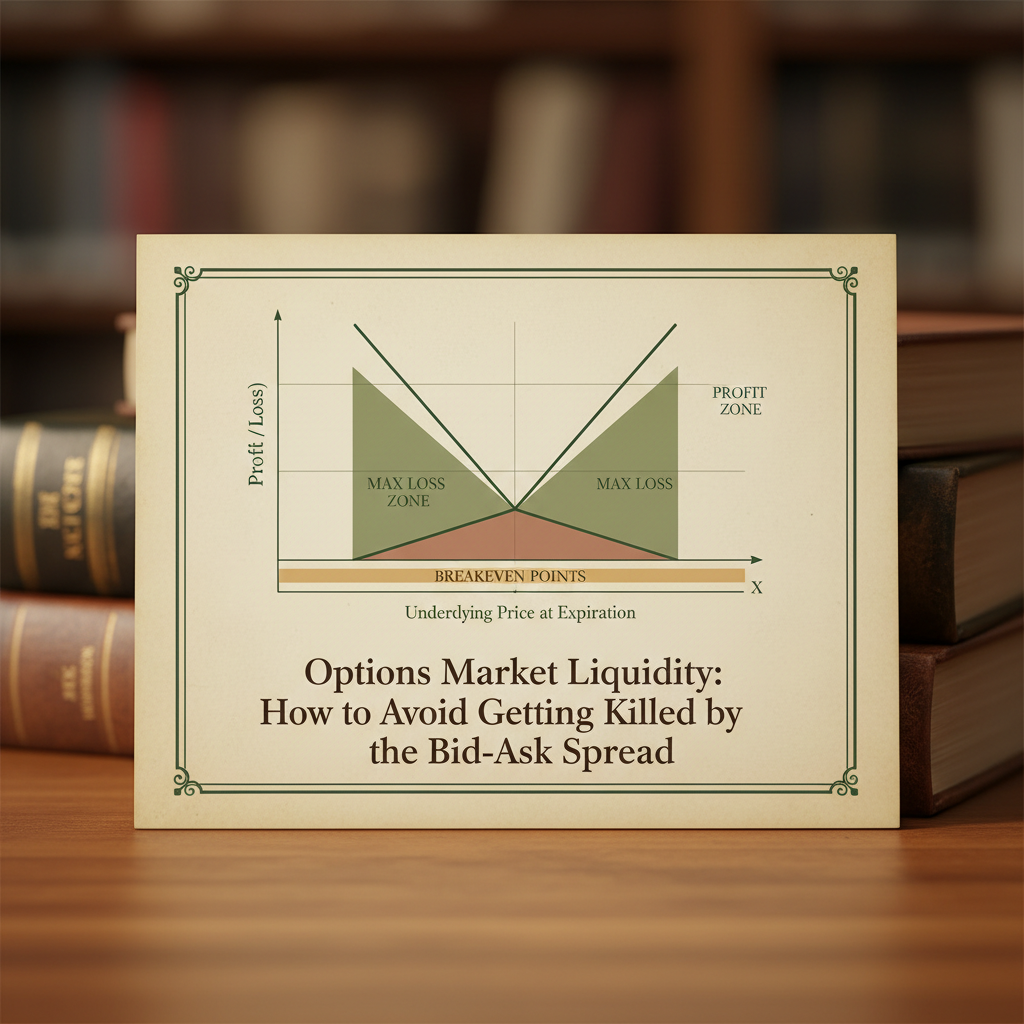
Options Market Liquidity: How to Avoid Getting Killed by the Bid-Ask Spread
Options Market Liquidity: How to Avoid Getting Killed by the Bid-Ask Spread
In the high-stakes world of options trading, where every penny counts, understanding and navigating options market liquidity is not just an advantage—it's a survival skill. Many traders, especially those new to the derivatives arena, focus intensely on directional calls, implied volatility, and intricate strategies, often overlooking a silent killer of profits: the bid-ask spread options. This seemingly small gap between what buyers are willing to pay and sellers are willing to accept can erode potential gains, magnify losses, and even render otherwise profitable strategies untenable.
At Volatility Anomaly, we constantly emphasize that successful options trading is a holistic endeavor, combining robust strategy selection with meticulous execution and rigorous risk management. Today, we're diving deep into the often-underestimated realm of options market microstructure, dissecting how liquidity impacts your bottom line and, crucially, how to leverage this knowledge to your advantage. We'll show you how to evaluate options liquidity using key metrics like open interest, volume, and the bid-ask spread as a percentage of the mid-price, providing actionable insights that can immediately improve your trade execution.
Consider a scenario: you've identified a perfect trade setup on a high-IV stock, perhaps selling an out-of-the-money call on XYZ with an IV Rank of 85%. The theoretical edge is compelling. But if that option has a bid of $0.50 and an ask of $0.80, you're instantly surrendering $0.30 per contract just to enter the trade. On 10 contracts, that's $300 that never even hit your account. Multiply that across dozens of trades, and you'll quickly understand why mastering liquidity is paramount. This article will equip you with the tools and knowledge to avoid these hidden costs, ensuring your hard-earned analytical edge isn't squandered by poor execution.
Why Options Market Liquidity Matters Now More Than Ever
Why Options Market Liquidity Matters Now More Than Ever
The options market has undergone a dramatic transformation over the last decade. The proliferation of retail trading platforms, zero-commission trading, and the rise of "meme stocks" have brought unprecedented levels of participation. While this has generally increased overall market depth, it has also created pockets of extreme illiquidity, particularly in less popular tickers or far out-of-the-money (OTM) strikes. The COVID-19 pandemic further exacerbated volatility, leading to wider spreads and choppier markets, especially during periods of high uncertainty.
Furthermore, the increasing popularity of complex multi-leg strategies, such as iron condors, butterflies, and calendar spreads, makes liquidity an even more critical factor. Each leg of these strategies incurs its own bid-ask spread cost. If you're constructing an iron condor with four legs, and each leg has a $0.10 spread, you're immediately giving up $0.40 per contract on entry and potentially another $0.40 on exit. This can quickly turn a theoretically profitable trade into a losing one, especially for strategies with relatively small maximum profits, like short premium trades.
The current market environment, characterized by persistent inflation concerns, rising interest rates, and geopolitical tensions, often leads to elevated implied volatility. While high IV can present attractive opportunities for premium sellers, it also tends to widen bid-ask spreads as market makers demand greater compensation for the increased risk they undertake. This makes understanding and managing bid ask spread options not just a good practice, but an essential component of profitable trading.
For instance, consider the VIX index, which recently hovered around the 18-22 level. While not historically extreme, this elevated baseline can still translate to wider spreads on individual equity options, especially those with lower trading volumes. Traders relying solely on theoretical pricing models without accounting for real-world execution costs will find their P&L significantly divergent from their expectations. Our Volatility Anomaly system, which identifies high-probability trade setups, always factors in liquidity metrics to ensure our weekly picks are not only theoretically sound but also practically executable.
Core Concept Deep Dive: Evaluating Options Liquidity
Core Concept Deep Dive: Evaluating Options Liquidity
Evaluating options liquidity is a multi-faceted process that goes beyond simply looking at the bid and ask prices. It involves analyzing several key metrics that, when combined, paint a comprehensive picture of how easily and efficiently you can enter and exit a position without significant slippage. The three primary indicators we focus on are Open Interest, Volume, and the Bid-Ask Spread as a Percentage of the Mid-Price.
Open Interest (OI)
Open Interest (OI)
Open Interest represents the total number of outstanding options contracts for a particular strike price and expiration that have not yet been closed or exercised. It's a measure of market participation and commitment. High open interest indicates that many traders hold positions at that specific strike, suggesting a deeper market and potentially better liquidity. Think of it as the "depth" of the market at that strike.
    - **What to look for:** Generally, higher OI is better. For actively traded options, you want to see OI in the hundreds or thousands for a given strike.

    - **Why it matters:** High OI means there are more participants, increasing the likelihood that your order will be filled quickly and at a favorable price. It also suggests that market makers are more comfortable quoting tighter spreads because they can more easily hedge their positions.

    - **Example:** On a typical day, SPY options will show OI in the tens of thousands for near-the-money strikes, while a less popular stock like ZM might only have a few hundred. If you're looking at a SPY call option with a 450 strike expiring in 30 days, and it has an OI of 50,000, that's a strong indicator of liquidity. Conversely, a call on a small-cap biotech stock with an OI of 50 for a similar strike and expiration would be a red flag.


Volume
    - **What to look for:** Generally, higher OI is better. For actively traded options, you want to see OI in the hundreds or thousands for a given strike.

    - **Why it matters:** High OI means there are more participants, increasing the likelihood that your order will be filled quickly and at a favorable price. It also suggests that market makers are more comfortable quoting tighter spreads because they can more easily hedge their positions.

    - **Example:** On a typical day, SPY options will show OI in the tens of thousands for near-the-money strikes, while a less popular stock like ZM might only have a few hundred. If you're looking at a SPY call option with a 450 strike expiring in 30 days, and it has an OI of 50,000, that's a strong indicator of liquidity. Conversely, a call on a small-cap biotech stock with an OI of 50 for a similar strike and expiration would be a red flag.


Volume
Volume represents the total number of contracts traded for a particular strike price and expiration during the current trading day. While Open Interest tells you about existing positions, Volume tells you about current activity. It's a measure of the "activity" or "flow" at that strike.
    - **What to look for:** High daily volume indicates active trading. For liquid options, you'd typically want to see volume in the hundreds or thousands.

    - **Why it matters:** High volume means there's constant buying and selling interest, which helps to keep spreads tight. It suggests that market makers are actively facilitating trades.

    - **Distinction from OI:** A strike can have high OI but low current volume if many traders are holding positions but not actively trading them today. Conversely, a strike can have high volume but relatively low OI if a large number of contracts were traded and then immediately closed, or if it's a new, popular strike. Ideally, you want to see both high OI and high volume for optimal liquidity.

    - **Example:** For QQQ options, a call with a 420 strike and 10 days to expiration might have an OI of 25,000 and a daily volume of 15,000 contracts. This combination suggests excellent liquidity. If the OI was 25,000 but the volume was only 50, it would suggest that while many people hold positions, there isn't much active trading happening right now, which could lead to wider spreads if you try to enter or exit.


Bid-Ask Spread as a Percentage of Mid-Price
    - **What to look for:** High daily volume indicates active trading. For liquid options, you'd typically want to see volume in the hundreds or thousands.

    - **Why it matters:** High volume means there's constant buying and selling interest, which helps to keep spreads tight. It suggests that market makers are actively facilitating trades.

    - **Distinction from OI:** A strike can have high OI but low current volume if many traders are holding positions but not actively trading them today. Conversely, a strike can have high volume but relatively low OI if a large number of contracts were traded and then immediately closed, or if it's a new, popular strike. Ideally, you want to see both high OI and high volume for optimal liquidity.

    - **Example:** For QQQ options, a call with a 420 strike and 10 days to expiration might have an OI of 25,000 and a daily volume of 15,000 contracts. This combination suggests excellent liquidity. If the OI was 25,000 but the volume was only 50, it would suggest that while many people hold positions, there isn't much active trading happening right now, which could lead to wider spreads if you try to enter or exit.


Bid-Ask Spread as a Percentage of Mid-Price
This is arguably the most direct and crucial measure of liquidity. It quantifies the cost of entering and exiting a trade relative to the option's theoretical value. A narrow spread means lower transaction costs and better execution. We normalize it by expressing it as a percentage of the mid-price to allow for apples-to-apples comparison across different option prices.
    - **Calculation:** <code>((Ask Price - Bid Price) / ((Bid Price + Ask Price) / 2)) * 100</code>

    - **What to look for:** As a general rule, aim for spreads that are 5% or less of the mid-price. For highly liquid options like SPY or QQQ, you can often find spreads under 2%. For less liquid options, you might tolerate up to 10%, but anything higher should be approached with extreme caution.

    - **Why it matters:** This percentage directly tells you how much you're giving up in slippage. If an option has a mid-price of $1.00 and a 10% spread, you're effectively losing $0.10 per contract on entry and another $0.10 on exit, totaling $0.20 per contract. If your maximum profit on a short premium strategy is $0.50, you've already sacrificed 40% of your potential gain to transaction costs.

    - **Factors influencing spread width:**

            - **Underlying Stock Liquidity:** Highly liquid stocks (e.g., AAPL, MSFT) generally have tighter options spreads.

            - **Time to Expiration:** Shorter-dated options (especially weeklys) often have tighter spreads due to higher trading activity, but this isn't always the case for very OTM strikes. Longer-dated LEAPS can have wider spreads.

            - **Moneyness:** At-the-money (ATM) and slightly out-of-the-money (OTM) options tend to have the tightest spreads due to the highest trading volume. Far OTM or deep in-the-money (ITM) options typically have wider spreads.

            - **Implied Volatility:** Higher IV can sometimes lead to wider spreads as market makers price in greater uncertainty.

            - **Market Maker Competition:** More market makers competing for order flow generally leads to tighter spreads.


    - **Example:** Let's say you're looking at an AAPL call option with a 180 strike, 30 DTE.

            - Bid: $2.50, Ask: $2.60

            - Mid-price: ($2.50 + $2.60) / 2 = $2.55

            - Spread: $2.60 - $2.50 = $0.10

            - Percentage Spread: ($0.10 / $2.55) * 100 = 3.92%. This is a very acceptable spread.


        Now consider a less liquid option on a smaller company, XYZ, with a 50 strike, 30 DTE:

            - Bid: $1.20, Ask: $1.50

            - Mid-price: ($1.20 + $1.50) / 2 = $1.35

            - Spread: $1.50 - $1.20 = $0.30

            - Percentage Spread: ($0.30 / $1.35) * 100 = 22.22%. This spread is prohibitively wide and would make profitable trading extremely difficult.


<blockquote>
    - **Calculation:** <code>((Ask Price - Bid Price) / ((Bid Price + Ask Price) / 2)) * 100</code>

    - **What to look for:** As a general rule, aim for spreads that are 5% or less of the mid-price. For highly liquid options like SPY or QQQ, you can often find spreads under 2%. For less liquid options, you might tolerate up to 10%, but anything higher should be approached with extreme caution.

    - **Why it matters:** This percentage directly tells you how much you're giving up in slippage. If an option has a mid-price of $1.00 and a 10% spread, you're effectively losing $0.10 per contract on entry and another $0.10 on exit, totaling $0.20 per contract. If your maximum profit on a short premium strategy is $0.50, you've already sacrificed 40% of your potential gain to transaction costs.

    - **Factors influencing spread width:**

            - **Underlying Stock Liquidity:** Highly liquid stocks (e.g., AAPL, MSFT) generally have tighter options spreads.

            - **Time to Expiration:** Shorter-dated options (especially weeklys) often have tighter spreads due to higher trading activity, but this isn't always the case for very OTM strikes. Longer-dated LEAPS can have wider spreads.

            - **Moneyness:** At-the-money (ATM) and slightly out-of-the-money (OTM) options tend to have the tightest spreads due to the highest trading volume. Far OTM or deep in-the-money (ITM) options typically have wider spreads.

            - **Implied Volatility:** Higher IV can sometimes lead to wider spreads as market makers price in greater uncertainty.

            - **Market Maker Competition:** More market makers competing for order flow generally leads to tighter spreads.


    - **Example:** Let's say you're looking at an AAPL call option with a 180 strike, 30 DTE.

            - Bid: $2.50, Ask: $2.60

            - Mid-price: ($2.50 + $2.60) / 2 = $2.55

            - Spread: $2.60 - $2.50 = $0.10

            - Percentage Spread: ($0.10 / $2.55) * 100 = 3.92%. This is a very acceptable spread.


        Now consider a less liquid option on a smaller company, XYZ, with a 50 strike, 30 DTE:

            - Bid: $1.20, Ask: $1.50

            - Mid-price: ($1.20 + $1.50) / 2 = $1.35

            - Spread: $1.50 - $1.20 = $0.30

            - Percentage Spread: ($0.30 / $1.35) * 100 = 22.22%. This spread is prohibitively wide and would make profitable trading extremely difficult.


<blockquote>
"The bid-ask spread is the tax you pay to trade. Smart traders minimize this tax."
</blockquote>
</blockquote>
By combining these three metrics – high Open Interest, high Volume, and a low Bid-Ask Spread as a percentage of mid-price – you can confidently identify options contracts with sufficient liquidity for efficient trading. Our Volatility Anomaly screeners are designed to filter for these very conditions, ensuring that the opportunities presented to our members meet stringent liquidity requirements.
Practical Application: Trading with Liquidity in Mind
Practical Application: Trading with Liquidity in Mind
Understanding liquidity metrics is one thing; applying them in real-time trading is another. Here, we'll walk through a practical example, demonstrating how to incorporate these principles into your trade entry, management, and exit strategies.
Scenario: Selling a Cash-Secured Put on SPY
Scenario: Selling a Cash-Secured Put on SPY
Let's assume the current market conditions are as follows:
    - **SPY Price:** $450.00

    - **VIX:** 18.50 (indicating moderate implied volatility)

    - **SPY IV Rank:** 45% (mid-range, not exceptionally high or low)

    - **Strategy:** Selling a Cash-Secured Put (CSP) to collect premium, targeting a delta of around -0.15 to -0.20, with approximately 30-45 days to expiration (DTE).


Step 1: Identifying Potential Strikes and Expirations
    - **SPY Price:** $450.00

    - **VIX:** 18.50 (indicating moderate implied volatility)

    - **SPY IV Rank:** 45% (mid-range, not exceptionally high or low)

    - **Strategy:** Selling a Cash-Secured Put (CSP) to collect premium, targeting a delta of around -0.15 to -0.20, with approximately 30-45 days to expiration (DTE).


Step 1: Identifying Potential Strikes and Expirations
We're looking for a put option with a delta around -0.15 to -0.20, giving us a reasonable probability of profit (POP) while collecting decent premium. Let's scan the option chain for SPY, focusing on the 40 DTE expiration (e.g., a specific monthly expiration cycle).
We find the following potential strikes:
    - **SPY 40 DTE $430 Put:** Delta -0.18

    - **SPY 40 DTE $425 Put:** Delta -0.14


Step 2: Evaluating Liquidity Metrics for Each Strike
    - **SPY 40 DTE $430 Put:** Delta -0.18

    - **SPY 40 DTE $425 Put:** Delta -0.14


Step 2: Evaluating Liquidity Metrics for Each Strike
Now, let's pull up the specific options chain data for these strikes (hypothetical real-time data):
Option 1: SPY 40 DTE $430 Put
    - **Bid:** $1.50

    - **Ask:** $1.55

    - **Mid-Price:** $1.525

    - **Spread:** $0.05

    - **Percentage Spread:** ($0.05 / $1.525) * 100 = 3.28%

    - **Open Interest:** 75,000 contracts

    - **Daily Volume:** 40,000 contracts
    - **Bid:** $1.50

    - **Ask:** $1.55

    - **Mid-Price:** $1.525

    - **Spread:** $0.05

    - **Percentage Spread:** ($0.05 / $1.525) * 100 = 3.28%

    - **Open Interest:** 75,000 contracts

    - **Daily Volume:** 40,000 contracts
Option 2: SPY 40 DTE $425 Put
    - **Bid:** $1.20

    - **Ask:** $1.28

    - **Mid-Price:** $1.24

    - **Spread:** $0.08

    - **Percentage Spread:** ($0.08 / $1.24) * 100 = 6.45%

    - **Open Interest:** 50,000 contracts

    - **Daily Volume:** 18,000 contracts


Step 3: Making the Selection Based on Liquidity
    - **Bid:** $1.20

    - **Ask:** $1.28

    - **Mid-Price:** $1.24

    - **Spread:** $0.08

    - **Percentage Spread:** ($0.08 / $1.24) * 100 = 6.45%

    - **Open Interest:** 50,000 contracts

    - **Daily Volume:** 18,000 contracts


Step 3: Making the Selection Based on Liquidity
Comparing the two:
    - The $430 Put has a significantly tighter percentage spread (3.28% vs. 6.45%).

    - The $430 Put also boasts higher Open Interest and Daily Volume, indicating a much more active and liquid market.
    - The $430 Put has a significantly tighter percentage spread (3.28% vs. 6.45%).

    - The $430 Put also boasts higher Open Interest and Daily Volume, indicating a much more active and liquid market.
Based on these liquidity metrics, the SPY 40 DTE $430 Put is the clear winner. While the $425 put offers a slightly lower delta (higher POP), the wider spread significantly eats into the premium collected. If we sold 10 contracts of the $430 put, our immediate "cost" for the spread would be $0.05 * 10 = $50. For the $425 put, it would be $0.08 * 10 = $80. This difference is substantial, especially on smaller trades.
Step 4: Executing the Trade with Limit Orders
Step 4: Executing the Trade with Limit Orders
Never use market orders for options, especially if you're concerned about the bid-ask spread. Always use limit orders.
For the SPY 40 DTE $430 Put (Bid $1.50, Ask $1.55), we want to sell it for as much premium as possible. A good starting point for a limit order is the mid-price, or slightly above it if you're patient. Let's try to sell at $1.53.
Entry Order: Sell 10 SPY 40 DTE $430 Puts @ $1.53 Limit.
If the order doesn't fill immediately, you can adjust your limit order down by a penny or two ($1.52, then $1.51) until it fills. The goal is to get as close to the ask (for buying) or bid (for selling) as possible without crossing the spread unnecessarily.
Step 5: Managing the Trade and Exiting
Step 5: Managing the Trade and Exiting
Let's say the trade goes well, SPY stays above $430, and with 10 DTE remaining, the put has decayed significantly. The SPY 10 DTE $430 Put now has a Bid of $0.20 and an Ask of $0.23. We want to buy it back to close the position.
    - **Mid-Price:** $0.215

    - **Spread:** $0.03

    - **Percentage Spread:** ($0.03 / $0.215) * 100 = 13.95%
    - **Mid-Price:** $0.215

    - **Spread:** $0.03

    - **Percentage Spread:** ($0.03 / $0.215) * 100 = 13.95%
Notice how the percentage spread has widened as the option becomes cheaper and closer to expiration (though the absolute spread might be smaller). This is common for very cheap options. Even with a 13.95% spread, the absolute cost is only $0.03 per contract. We aim to buy back at $0.21.
Exit Order: Buy 10 SPY 10 DTE $430 Puts @ $0.21 Limit.
Total Profit: (Premium Collected - Premium Paid) * Number of Contracts
($1.53 - $0.21) * 10 = $1.32 * 10 = $1,320 (before commissions).
Had we ignored liquidity and used market orders, we might have sold at $1.50 and bought back at $0.23, reducing our profit to ($1.50 - $0.23) * 10 = $1.27 * 10 = $1,270. That's a $50 difference on a single trade, purely due to bid-ask spread management. Over many trades, this adds up significantly.
The Volatility Anomaly platform provides real-time liquidity metrics for all our recommended trades, including the percentage spread, allowing members to make informed decisions and optimize their entries and exits. Our position monitoring tools also help track these metrics as the trade evolves, signaling when it's opportune to adjust or close.
Risk Management in the Face of Illiquidity
Risk Management in the Face of Illiquidity
While understanding liquidity helps optimize entries and exits, it's equally crucial for managing risk. Trading illiquid options introduces several unique risks that can severely impact your capital.
1. Slippage and Execution Risk
1. Slippage and Execution Risk
The most obvious risk is significant slippage. If you need to enter or exit an illiquid position quickly, especially during volatile market conditions, you might be forced to cross the spread entirely, accepting a price far worse than the mid-price. This can turn a small loss into a large one, or wipe out a significant portion of your profit. For example, if you're short an illiquid call that suddenly goes deep in-the-money, and you try to buy it back with a market order, you could pay substantially more than the last traded price.
2. Difficulty in Adjusting Trades
2. Difficulty in Adjusting Trades
Many options strategies involve adjustments (e.g., rolling positions, adding legs). If the options you're trading are illiquid, making these adjustments becomes challenging and costly. You might find it impossible to roll a put down and out for a credit if the bid on the existing put is too low and the ask on the new put is too high.
3. Inaccurate Pricing and Valuation
3. Inaccurate Pricing and Valuation
Illiquid options often have stale quotes or wide spreads that don't accurately reflect their true theoretical value. Your P&L calculations might be based on mid-prices that are not realistically achievable. This can lead to a false sense of security or misjudgment of risk. A portfolio tracking system might show a profit, but if you can't exit at those prices, it's merely a paper gain.
4. Assignment Risk and Early Exercise
4. Assignment Risk and Early Exercise
While not directly tied to the bid-ask spread, illiquid options can exacerbate assignment risks. If you're short an illiquid option that goes ITM, and the underlying stock is hard to borrow (for calls) or hard to short (for puts), managing assignment can be problematic. This is more prevalent with individual stocks, less so with highly liquid ETFs like SPY or QQQ.
Mitigating Illiquidity Risks:

    - **Strict Liquidity Filters:** As a rule, only trade options that meet your minimum liquidity criteria (e.g., percentage spread < 5%, OI > 500, Volume > 100). Our Volatility Anomaly screeners enforce these filters rigorously.

    - **Always Use Limit Orders:** This is non-negotiable. It gives you control over your execution price and prevents you from being taken advantage of by market makers.

    - **Patience and Price Discovery:** Don't rush your orders. If your limit order isn't filling, try adjusting by a penny or two. Sometimes, simply waiting a few minutes can bring a better price as market makers update their quotes or new order flow comes in.

    - **Trade During Peak Hours:** The most liquid times for options trading are generally between 9:30 AM ET and 3:30 PM ET. Avoid trading during the first and last 30 minutes of the day, as spreads tend to widen due to opening/closing order imbalances.

    - **Focus on Major ETFs and Large-Cap Stocks:** SPY, QQQ, IWM, TLT, AAPL, MSFT, AMZN, GOOGL, TSLA, NVDA are almost always liquid. Venture into smaller-cap stocks or less popular ETFs with extreme caution.

    - **Size Your Positions Appropriately:** Trading large quantities of illiquid options will only worsen your execution. Keep position sizes small when liquidity is questionable.

    - **Consider Spreads vs. Single Legs:** While multi-leg strategies incur multiple spread costs, they can sometimes be easier to fill as a single contingent order than trying to leg into each component. However, the overall liquidity of the strategy still depends on its individual legs.


Advanced Considerations for Experienced Traders
Mitigating Illiquidity Risks:

    - **Strict Liquidity Filters:** As a rule, only trade options that meet your minimum liquidity criteria (e.g., percentage spread < 5%, OI > 500, Volume > 100). Our Volatility Anomaly screeners enforce these filters rigorously.

    - **Always Use Limit Orders:** This is non-negotiable. It gives you control over your execution price and prevents you from being taken advantage of by market makers.

    - **Patience and Price Discovery:** Don't rush your orders. If your limit order isn't filling, try adjusting by a penny or two. Sometimes, simply waiting a few minutes can bring a better price as market makers update their quotes or new order flow comes in.

    - **Trade During Peak Hours:** The most liquid times for options trading are generally between 9:30 AM ET and 3:30 PM ET. Avoid trading during the first and last 30 minutes of the day, as spreads tend to widen due to opening/closing order imbalances.

    - **Focus on Major ETFs and Large-Cap Stocks:** SPY, QQQ, IWM, TLT, AAPL, MSFT, AMZN, GOOGL, TSLA, NVDA are almost always liquid. Venture into smaller-cap stocks or less popular ETFs with extreme caution.

    - **Size Your Positions Appropriately:** Trading large quantities of illiquid options will only worsen your execution. Keep position sizes small when liquidity is questionable.

    - **Consider Spreads vs. Single Legs:** While multi-leg strategies incur multiple spread costs, they can sometimes be easier to fill as a single contingent order than trying to leg into each component. However, the overall liquidity of the strategy still depends on its individual legs.


Advanced Considerations for Experienced Traders
For those who have mastered the basics of liquidity, there are deeper layers to explore within options market microstructure that can provide an even finer edge.
1. Understanding Market Maker Behavior and Order Book Dynamics
1. Understanding Market Maker Behavior and Order Book Dynamics
Market makers are the backbone of options liquidity, providing bids and asks to facilitate trading. Their behavior is influenced by various factors:
    - **Inventory Risk:** If a market maker accumulates too much long or short inventory of an option, they will widen their spreads to discourage further trades in that direction and encourage trades that help them balance their books.

    - **Hedging Costs:** Market makers hedge their options positions by trading the underlying stock. If the stock itself is illiquid or highly volatile, their hedging costs increase, leading to wider options spreads.

    - **Information Asymmetry:** In periods of high uncertainty or breaking news, market makers widen spreads to protect themselves from informed traders who might have an edge.
    - **Inventory Risk:** If a market maker accumulates too much long or short inventory of an option, they will widen their spreads to discourage further trades in that direction and encourage trades that help them balance their books.

    - **Hedging Costs:** Market makers hedge their options positions by trading the underlying stock. If the stock itself is illiquid or highly volatile, their hedging costs increase, leading to wider options spreads.

    - **Information Asymmetry:** In periods of high uncertainty or breaking news, market makers widen spreads to protect themselves from informed traders who might have an edge.
Experienced traders can sometimes "read" the order book (Level 2 data) to gauge market maker interest. A large number of small orders on both sides of the spread indicates active participation, while a few large orders might suggest a less robust market. While not always accessible or practical for retail traders, understanding these underlying dynamics helps explain why spreads behave the way they do.
2. The Implied Volatility Surface and Liquidity
2. The Implied Volatility Surface and Liquidity
The implied volatility surface (or "skew") is a 3D plot showing implied volatility across different strike prices and expirations. Liquidity often correlates with the smoothness and consistency of this surface. Gaps or irregularities in the IV surface can indicate illiquid strikes where market makers are less active or have wider pricing discrepancies. Our Volatility Anomaly tools often visualize this surface to identify potential mispricings, but also to flag areas of poor liquidity.
3. Utilizing Complex Order Types and Algorithms
3. Utilizing Complex Order Types and Algorithms
Beyond simple limit orders, some brokers offer advanced order types that can help navigate illiquidity:
    - **Mid-Point Peg Orders:** These orders attempt to fill at the exact mid-point of the bid-ask spread and automatically adjust if the mid-point changes.

    - **Iceberg Orders:** For very large orders, an iceberg order breaks it into smaller, visible components to avoid revealing the full size of the order and impacting the market. (More for institutional traders).

    - **Contingent Orders (e.g., One-Cancels-Other, One-Triggers-Other):** While not directly for liquidity, these help manage complex strategies by ensuring that if one leg fills, the others are placed or canceled, reducing the risk of being partially filled in illiquid markets.
    - **Mid-Point Peg Orders:** These orders attempt to fill at the exact mid-point of the bid-ask spread and automatically adjust if the mid-point changes.

    - **Iceberg Orders:** For very large orders, an iceberg order breaks it into smaller, visible components to avoid revealing the full size of the order and impacting the market. (More for institutional traders).

    - **Contingent Orders (e.g., One-Cancels-Other, One-Triggers-Other):** While not directly for liquidity, these help manage complex strategies by ensuring that if one leg fills, the others are placed or canceled, reducing the risk of being partially filled in illiquid markets.
For multi-leg strategies, submitting the entire spread as a single order (e.g., an iron condor as one order) is almost always preferable to legging into it. The market maker will quote a net price for the entire spread, and you only pay one net spread, rather than four individual spreads. This is a critical technique for managing spread costs in complex strategies.
4. The Impact of Electronic Trading and High-Frequency Trading (HFT)
4. The Impact of Electronic Trading and High-Frequency Trading (HFT)
HFT firms play a significant role in providing liquidity, constantly quoting bids and asks and profiting from tiny price discrepancies. While they generally tighten spreads, their presence also means that prices can move extremely quickly. This emphasizes the need for fast execution and precise limit orders. In less liquid options, HFT presence might be minimal, leading to wider, more persistent spreads.
Ultimately, for advanced traders, understanding these nuances of options market microstructure allows for a more sophisticated approach to trade selection and execution, turning potential pitfalls into opportunities for superior performance.
Conclusion & Key Takeaways
Conclusion & Key Takeaways
The bid-ask spread is not merely a minor transaction cost; it's a fundamental aspect of options trading that can make or break your profitability. Ignoring options market liquidity is akin to sailing into a storm without checking the weather—you might get lucky, but you're significantly increasing your risk of capsizing. By diligently evaluating open interest, volume, and the bid-ask spread as a percentage of the mid-price, you equip yourself with the knowledge to navigate the options market efficiently and effectively.
At Volatility Anomaly, our mission is to empower traders with actionable insights and robust tools. Our system is built on the principle that a thorough understanding of market mechanics, including liquidity, is just as vital as identifying high-probability setups. By integrating these liquidity checks into your trading routine, you'll not only avoid unnecessary slippage but also gain a clearer picture of the true cost and potential of every trade you consider.
Don't let the silent tax of the bid-ask spread erode your hard-earned edge. Master liquidity, and you'll master a crucial element of consistent profitability in options trading.
Key Takeaways:

    - **Prioritize Liquidity:** Always assess options liquidity before placing a trade. It's as important as implied volatility or directional bias.

    - **Key Metrics:** Focus on high Open Interest (hundreds/thousands), high Volume (hundreds/thousands), and a tight Bid-Ask Spread (ideally <5% of mid-price, especially for premium selling).

    - **Calculate Percentage Spread:** Use <code>((Ask - Bid) / Mid-Price) * 100</code> to normalize spread costs and compare options effectively.

    - **Always Use Limit Orders:** Never use market orders for options. Place limit orders at or near the mid-price and be patient, adjusting by a penny or two if necessary.

    - **Stick to Liquid Underlyings:** Focus on major ETFs (SPY, QQQ, IWM) and large-cap stocks (AAPL, MSFT, AMZN) known for their deep options markets.

    - **Manage Multi-Leg Spreads:** For complex strategies, submit the entire spread as a single order to minimize overall transaction costs.

    - **Integrate into Strategy:** Make liquidity analysis a non-negotiable part of your trade entry and exit checklist to protect your capital and maximize profitability.
Key Takeaways:

    - **Prioritize Liquidity:** Always assess options liquidity before placing a trade. It's as important as implied volatility or directional bias.

    - **Key Metrics:** Focus on high Open Interest (hundreds/thousands), high Volume (hundreds/thousands), and a tight Bid-Ask Spread (ideally <5% of mid-price, especially for premium selling).

    - **Calculate Percentage Spread:** Use <code>((Ask - Bid) / Mid-Price) * 100</code> to normalize spread costs and compare options effectively.

    - **Always Use Limit Orders:** Never use market orders for options. Place limit orders at or near the mid-price and be patient, adjusting by a penny or two if necessary.

    - **Stick to Liquid Underlyings:** Focus on major ETFs (SPY, QQQ, IWM) and large-cap stocks (AAPL, MSFT, AMZN) known for their deep options markets.

    - **Manage Multi-Leg Spreads:** For complex strategies, submit the entire spread as a single order to minimize overall transaction costs.

    - **Integrate into Strategy:** Make liquidity analysis a non-negotiable part of your trade entry and exit checklist to protect your capital and maximize profitability.